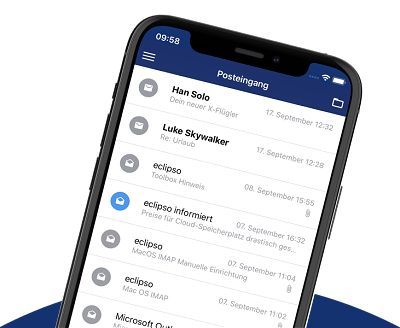
Email Filter Rules - Automatic Sorting Like Gmail Labels & Outlook Rules
Email Filter Rules - Automatic Sorting Like Gmail Labels & Outlook Rules
You know Gmail Labels or Outlook Rules and want to automatically sort, mark or forward your emails? With eclipso Mail Europe's Filter Rules you have an even more powerful tool at your disposal!
What are Filter Rules?
Filter Rules are automatic instructions that determine what should happen to incoming emails. Similar to:
- Gmail Labels: Automatically categorize and color-code emails
- Outlook Rules: Move emails to folders or mark as important
- Thunderbird Filters: Automatic sorting by sender or subject
The difference: With us, you can combine multiple actions in a single rule (e.g., move + color-mark + send notification) – without having to create multiple filters or labels!
Where do I find Filter Rules?
Settings → Email | Filters
 Filter Rules are only available in all tariffs. You can create up to 50 filters and combine them as desired.
The 5 Most Common Use Cases
1. Automatically Sort Newsletters (Like Gmail Labels)
Problem: Newsletters flood your inbox.
Solution:
- Create a "Newsletter" folder
- Create filter rule:
From contains "newsletter@"ORSubject contains "[Newsletter]" - Action: Move to Newsletter folder
- Optional: Mark as read (no more red dot)
Example:
- 🔀 Condition: From contains "newsletter@" OR Subject starts with "[Newsletter]"
- ✅ Action: Move → Newsletter folder + Mark as read
Advantage over Gmail: With Gmail you need a label + a filter. With us it's ONE rule!2. Highlight Important Emails (VIP Marking)
Problem: Important emails from your boss or clients get lost in the inbox.
Solution:
- Create filter rule:
From = "boss@company.com"ORFrom = "important-client@example.com" - Combine actions: Mark (flag) + Set color (Red) + SMS notification
Example:
- 🔀 Condition: From = "boss@company.com" OR From ends with "@important-domain.com"
- ✅ Action: Mark (flag) + Color Red + SMS to mobile
Unique: SMS notification is available in neither Gmail nor Outlook!3. Filter Spam and Unwanted Emails
Problem: Despite spam filter, unwanted emails get through.
Solution:
- Create filter rule:
From contains "@spam-domain.com"ORSubject contains "Lottery" - Action: Mark as spam + Move to Spam folder + Stop rule processing
Important: Do NOT use the "Delete" action unless you're 100% sure! Better: Move to Spam folder so you can still recover accidentally filtered emails.
Example:
- 🔀 Condition: From contains "@scam-site.ru" OR Subject contains "You have won"
- ✅ Action: Mark as spam + Move → Spam folder
4. Set Up Vacation Responder (Out of Office Message)
Problem: You're on vacation and want to automatically reply to emails.
Preparation:
- Create a draft with your out-of-office message (e.g., "I'm on vacation from Aug 1 to Aug 15...")
- Note the draft number (e.g., Draft #42)
Solution:
- Create filter rule:
From does not contain "noreply"(to exclude automatic emails) - Action: Auto-reply with Draft #42
Important:
- ✅ Activate filter BEFORE vacation
- ✅ Deactivate filter AFTER return (don't delete!)
- ✅ Next year: Update draft + reactivate filter
Advantage: Easier than Outlook's Out of Office Assistant and more flexible than Gmail's vacation responder!5. Automatically Archive Invoices
Problem: Manually moving invoices to folders is tedious.
Solution:
- Create an "Invoices" folder
- Create filter rule:
Attachment = YesANDAttachment list contains "Invoice" - Action: Move to Invoices folder + Set color (Green) + Mark (flag)
Example:
- 🔀 Condition: Attachment present AND Attachment list contains "Invoice.pdf"
- ✅ Action: Move → Invoices + Color Green + Mark
Perfect for accounting – all invoices automatically sorted!What Can I Filter? (Conditions)
Filter rules work through conditions (What should be filtered?) and actions (What should happen with it?).
Available Filter Fields:
- Subject: Filters by text in subject (e.g., "Invoice", "[Newsletter]", "URGENT")
- From (Sender): Filters by email address or domain (e.g., "boss@company.com", "@gmail.com")
- To (Recipient): Filters by recipient address (useful for alias addresses)
- CC (Copy): Filters by CC recipients
- Priority: Filters by email priority (High / Normal / Low)
- Attachment: Filters whether attachment is present (Yes / No)
- Attachment List: Filters by attachment filenames (e.g., "Invoice.pdf", ".jpg")
Comparison Operators:
- Is equal: Exact match (e.g., From = "boss@company.com")
- Contains: Text is contained somewhere (e.g., Subject contains "Newsletter")
- Starts with: Text is at the beginning (e.g., Subject starts with "[Important]")
- Ends with: Text is at the end (e.g., From ends with "@company.com")
- Is not equal / Does not contain: Negation of the above operators
Combining Multiple Conditions:
- AND (all conditions): All conditions must be met
Example: From = "boss@company.com" AND Subject contains "Project Alpha" - OR (at least one): At least one condition must be met
Example: From contains "newsletter@" OR Subject contains "[Newsletter]"
What Actions Can I Perform?
Filter rules can automatically perform various actions – You can combine multiple actions!
Organize:
- Move: Move email to another folder (e.g., Newsletter folder)
- Set color: Color-mark email (6 colors: Red, Orange, Yellow, Green, Blue, Purple)
- Mark (flag): Highlight email with flag
- Mark as read: Remove "unread" status
- Mark as spam: Mark email as spam
- Mark as done: Mark email as done (to-do system)
Notify:
- SMS notification: Send SMS to your mobile number (Pay with Credits)
- Email notification: Send notification email to another address (e.g., personal@gmail.com)
- Forward: Forward complete email to another address
Automate:
- Auto-reply: Send out-of-office message or standard reply (uses draft)
- Delete: Delete email immediately (Caution: Irreversible!)
- Stop rule processing: Don't execute further filters (useful for catch-all rules)
Tip: You can combine as many actions as you want! Example: Move + Set color + Mark + Send SMS – all in ONE rule!How Do I Create My First Filter? (Quick Start)
Step-by-Step Instructions:
- Log in to Webmail
- Go to Settings → Email | Filters
- Click "New Filter" or "+"
- Enter a title (e.g., "Sort newsletters")
- Add a condition:
- Field: "From"
- Operator: "contains"
- Value: "newsletter@" - Add an action:
- Action: "Move"
- Folder: "Newsletter" - Optional: Add more actions (e.g., "Mark as read")
- Click "Save"
- ✅ Done! From now on, all newsletters will be sorted automatically.
Test Filter:
- After creating: Click "Apply filters to inbox"
- The system shows statistics (e.g., "152 emails moved, 12 marked")
- Check your Newsletter folder – are the right emails there?
- If not: Edit filter, adjust conditions and test again
Pro Tips for Filter Rules
1. Pay Attention to Order:
Filters are processed in the order you specify (number 1, 2, 3, ...). Specific filters should come before general filters!
Example:
- VIP emails from boss (specific) → Mark red + flag
- Sort newsletters (specific) → Newsletter folder
- Spam filter (specific) → Spam folder
- All other emails (general) → Archive folder
2. Use "Stop Rule Processing":
When a filter executes the action "Stop rule processing", no further filters are executed. This prevents important emails from being moved by catch-all rules.
Example:
- Filter 1: VIP emails → Mark + Stop (important!)
- Filter 2: All emails → Archive (will NOT be executed for VIP emails)
3. Use Descriptive Names:
Give your filters clear names so you still know what they do months later.
Bad:
- "Filter 1"
- "My rule"
- "Test"
Good:
- "Newsletter → Newsletter folder"
- "VIP: Boss → Mark red"
- "Spam from @scam-site.ru → Delete"
4. DON'T Delete Immediately:
Only use the "Delete" action for 100% certain spam emails. Better: Move to Spam folder so you can still recover accidentally filtered emails.
Safer Workflow:
- New filter: Move to Trash (reversible)
- After 1 week: Check trash
- If everything OK: Change filter to Delete (irreversible)
5. Clean Up Filters Regularly:
Deactivate or delete filters you no longer need. This improves performance and overview.
Rule of Thumb:
- ✅ Up to 20 filters: Clear
- ⚠️ 20-50 filters: Still OK, but clean up
- ❌ Over 50 filters: Too many, performance suffers
Apply Filters to Inbox Retroactively
You've created a new filter and want to apply it to existing emails? No problem!
How to:
- Go to Settings → Email | Filters
- Click "Apply filters to inbox"
- The system processes all emails in the inbox and applies your filters
- You'll see statistics (e.g., "1,234 emails moved, 56 marked, 12 deleted")
Notes:
- Small mailboxes (< 5,000 emails): Immediate processing with progress bar
- Large mailboxes (≥ 5,000 emails): Background processing (background job), you can close the browser
- Duration: Depends on number of emails and filter complexity (approx. 5-10 minutes for 10,000 emails)
Frequently Asked Questions (FAQ)
Can I share filters with other users?
No, filters are user-specific. Each user must create their own filters.
Do filters work with POP3/IMAP retrieval?
Yes! Filters always work on receipt, regardless of protocol (Webmail, IMAP, POP3).
Can I export/import filters?
Not directly at the moment. However, you can document filters as screenshots and manually recreate them in another account.
How many filters can I create?
Technically unlimited, but we recommend a maximum of 50 filters for optimal performance.
What happens when multiple filters match an email?
All filters are executed sequentially (in order 1, 2, 3, ...), unless a filter has the action "Stop rule processing".
Can I deactivate filters instead of deleting them?
Yes! Deactivate the filter with the "Active" checkbox. Useful for vacation responders you want to reactivate next year.
What's the difference to Gmail Labels?
Gmail Labels are pure categories, while our filters can execute 13 different actions (incl. SMS, forwarding, auto-reply). Also: With Gmail you need a label + a filter, with us it's ONE rule!
What's the difference to Outlook Rules?
Very similar! The main difference: Our filters have SMS notification and simplified auto-responder – both don't exist in Outlook like this.
Summary:
Filter Rules are the Swiss Army knife for your email management:
- ✅ Automatic sorting like Gmail Labels
- ✅ Flexible rules like Outlook
- ✅ Multiple actions in one rule
- ✅ SMS notification (unique!)
- ✅ Easy vacation responder
- ✅ Retroactive application to inbox
Try it out – your first filter is created in 2 minutes!
Related Articles:
- Create and manage e-mail folders ↗
- What is a Intelligent Folder and how does it work? ↗
- Set retention time for e-mail folder ↗